
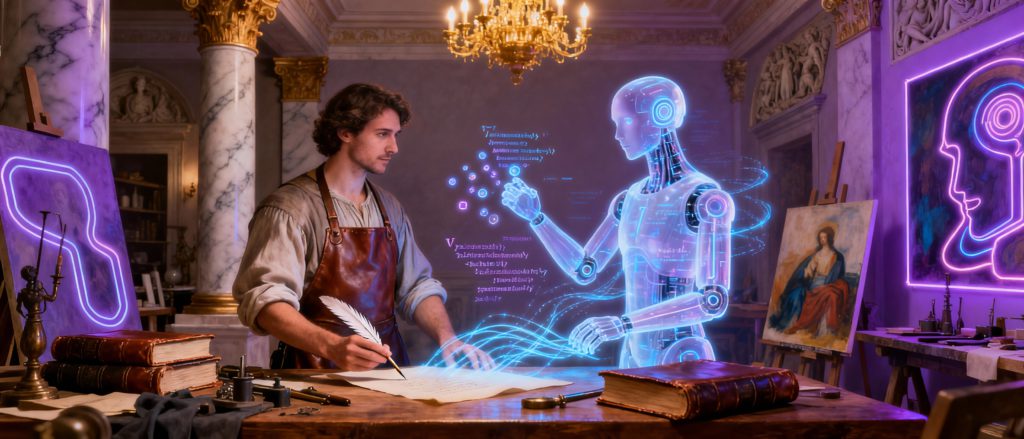
In every age, there is a quiet moment when power changes hands. Not in an election, not in a boardroom, but in the way ordinary people make things. In the 15th century, the printing press didn’t just make books cheaper; it democratized knowledge. In the late 20th century, the internet didn’t just connect us; it democratized distributing anything to the entire world. Now, Artificial Intelligence is not just automating tasks – it is democratizing creation.
We are entering what I call the Digital RenAIssance – not because it mimics the Italian Renaissance (though the parallels are eerie), but because it is a literal rebirth of the human capacity to create, augmented rather than replaced.
It is a new era defined not by machines that think for us, but by machines that think with us.
The creative power is shifting from those who can code, design, and ship… to those who can imagine clearly and collaborate with machines that finally speak human.
From Hex Keypads to Human Language
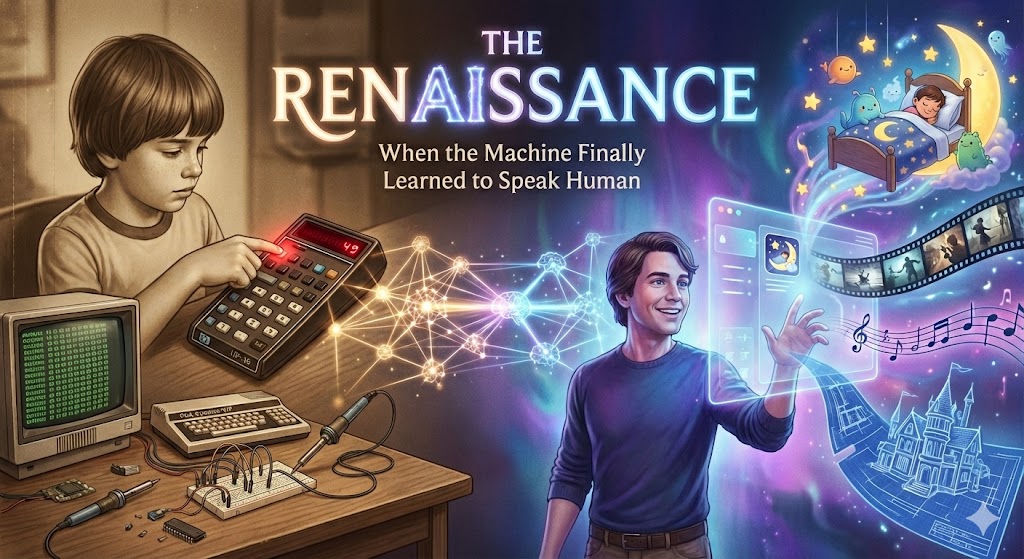
In the 1970s, using a computer meant surrendering your humanity at the door. You spoke in hexadecimal, addressed memory directly, and typed cryptic opcodes just to move a single dot across a screen. The burden was on you to think like a machine.
When I was 12, my dad brought home a bag of parts containing one of the very first computers you build yourself, the RCA Cosmac VIP. After I finished soldering it together, in a very real sense, to make it work, I had to think like a machine. That started with learning what was called “Machine Language“. To make a dot move on a screen, I couldn’t just say “move.” I had to input hexadecimal codes – literal 1s and 0s – into a keypad. I had to arrange the 1s and 0s in just the right order for the machine to do what I wanted it to do.
Here I was, one of the very first humans to tell a machine exactly what to do, and it did just that, with my “bugs” and all. I was enthralled!


For the last 50 years, this was the status quo. To use a computer, humans had to learn the computer’s language. We forced our fluid, creative, chaotic minds to think in rigid syntax, loops, and boolean logic. We became translators for the machines.
Now that relationship has flipped. Modern AI systems accept messy, emotional, ambiguous language and still return working software, functional interfaces, and serviceable architectures. The conversation has moved from “How do I say this in code?” to “What exactly do I want to exist in the world?”
When an App Starts as a Sentence
I’ve encountered many individuals who express anxiety about AI and harbor a fear of being replaced by any new technology, which is a natural response to change. At the same time, I have long envisioned a simple solution to allow busy and overworked parents and grandparents to engage the imagination of their children at bedtime. So I decided to create an app that would showcase a charming, harmless and empowering use of AI to help these people. But I am not a true professional developer in the modern sense. I don’t know the intricacies of React, Tailwind, or Firebase configurations. Yet – for the first time in my life – I didn’t need to.
I simply went to Firebase Studio and typed a single prompt in plain English:
“A productivity app for busy parents to entertain their child at bedtime with custom stories about their child texted to them at a scheduled time. Parents can enter their own phone number, the name of their child and the child’s interests (like space, football, music, etc.) and what time the story should arrive. Optionally the parent can text the service new components to add to the bedtime story (like visiting the dentist or being sick and home from school) The style should be whimsical and joyful using purple and blue hues.”
I did not write a line of code. The AI wrote the blueprint. It designed the database. It created the “Cron Jobs” to schedule the texts. It even named the app: “Dream Weaver.”
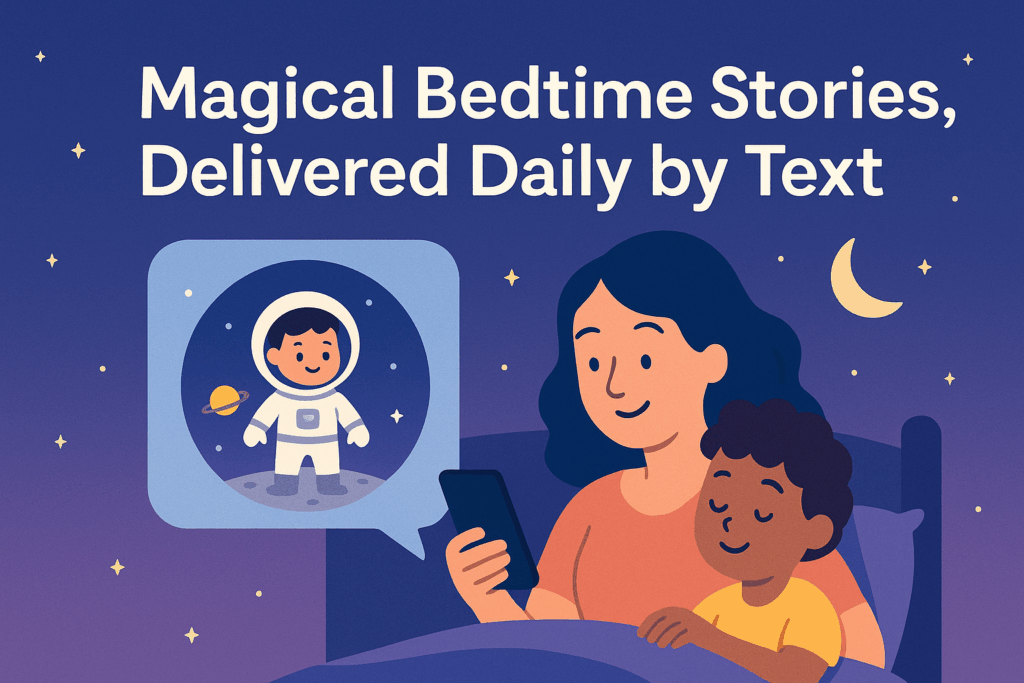
Dream Weaver began not as a product requirements document, but as a bedtime wish: a single paragraph asking for a whimsical app that texts custom stories about a child to a parent at a scheduled time. And it made me feel young again, renewing the same magic I felt programming my very first computer. Only this time, I could speak in my language and the machine understood me. I simply cannot understate how excited this made me as I no longer felt the excuse of “I don’t know how” get in the way of “I have this great idea…” (Anyone who knows me understands the liberation I now feel.)
Here is an irony of our modern age: It took me five times longer to get the phone carrier to approve my SMS registration to send txt messages than it took the AI to build the entire application. The bottleneck is no longer technology; it is now simply human effort.
Dream Weaver transforms the bedtime routine by using AI to generate unique, personalized stories based on your child’s specific interests, delivered conveniently via SMS link at your chosen time without requiring an app. Parents have full control to update profiles and preferences for tailored content, while Premium features unlock “Story Magic” to weave in additional real-life details like family events or milestones, allow for on-demand story generation, and even offer audio narrations. Designed with safety and privacy as top priorities, the service ensures child-friendly content through robust filtering and supports continuing adventures from previous nights to keep the magic alive.
Parenting
The Birth of the Vibe Coder
What emerges in this new environment is a different kind of creator: the vibe coder. A vibe coder does not obsess over semicolons or framework minutiae. Instead, this person describes outcomes precisely, treats AI like a brilliant but volatile junior engineer, and iterates through conversation rather than through raw keystrokes.
Building Dream Weaver exposed both the power and the volatility of this partnership. Generative models can scaffold entire backends, configure cron jobs, and stitch together third‑party APIs, then in the next breath “helpfully” refactor a working module into failure. They can forget their own prior decisions, misdiagnose configuration and platform issues, all while apologizing with the fluency of a seasoned customer support agent. Hmm, maybe they are more like us after all.
The practical lesson is sobering and empowering at once: you no longer need to be the hands that write every line, but you must be the mind that defines the boundaries, priorities, and safeguards. Anyone worried that AI will replace the human brain might focus their anxiety elsewhere. Aliens?
Every AI Project Needs a Constitution
In the Digital RenAIssance, serious creators are discovering that prompting is not enough. What they need is governance. One effective pattern is the “Our Rules” document I created: a short, explicit constitution pasted into every coding session to transform the AI from an over‑eager chaos engine into a constrained collaborator.
- Never overwrite the local .env file (my secrets).
- Never regress formatted API calls that are already working.
- Show me your plan before you write the code.
These rules are not about distrust; they are about channeling an almost unlimited generative capacity into a stable, evolving system. The RenAIssance creator becomes a product philosopher: designing guardrails, clarifying intent, and deciding what must remain invariant as everything else becomes fluid.
A New Division of Labor: Imagination vs. Execution
For most of modern history, creativity was tied to craft. If you could not draw, your visions lived and died in your head. If you could not code, your product ideas stalled at whiteboards and pitch decks. Now, execution is increasingly abundant, while original intent is scarce.
In practice, this means the question “Can you build this?” is being replaced by “Is this worth building?” The premium skill is no longer syntax, but sense‑making: identifying real needs and matching them with feasible, testable solutions.
The same tools that write your code can also manage your backlog, track enhancements, and help refine your business model, if you let them. The risk is not that AI will take away the capacity to create, but that humans will stop exercising the responsibility to choose wisely among the infinite things that could now be created.
The practical lesson is sobering and empowering at once: you no longer need to be the hands that write every line, but you must be the mind that defines the boundaries, priorities, and safeguards.
Steve Chazin, skytech.io
Practical Tips for the Digital RenAIssance Creator
Here are some tips I learned working with my Digital RenAIssistant I hope might make your experience a bit easier.
- Treat AI as a collaborator with context. Start each session by re‑establishing goals, constraints, and non‑negotiables rather than assuming the model remembers.
- Separate experimentation from production. Maintain a scratchboard where the AI can propose wild refactors or new architectures without jeopardizing the stable core of your app. At the same time, the cost of undoing an AI change is near zero. This unlocks fearless experimentation instead of months of hand-wringing.
- Ask for plans before code. Request architectural diagrams, step‑by‑step strategies, or pseudo‑code first, then iterate on the design before implementation begins. Precisely what you would do if you were building a new house or an addition. 
- Use multiple perspectives. Copy code or designs into different AI systems and compare their reasoning, not just their outputs, the way a good editor seeks multiple peer reviews. Grok, Claude, ChatGPT, Gemini and Perplexity know each other exist.
The Academic Stakes: Rethinking Literacy Itself
Historically, each major communication technology has redefined what it means to be literate. The printing press expanded reading and writing; the internet added navigation and critical filtering of information. Foundation models now add a new layer: directive literacy – the ability to specify, constrain, and govern non‑human agents that act on the world.
In this sense, vibe coding is not a niche maker skill; it is an early form of a general competency future citizens will need. Knowing how to write an “Our Rules” document, how to distinguish between experimentation and production, and how to interrogate an AI’s output is as structurally important as learning algebra once was.
Our New Human Condition
We are standing at the threshold of the greatest expansion of human creativity in history. There is no “I don’t know how” anymore.
- You do not need to be a trained illustrator to produce art.
- You do not need to be a trained filmmaker to make movies.
- You do not need to be a trained musician to make music.
- And you do not need to be a trained programmer to build software.
The barrier to entry has collapsed. The “how” has been solved. The only question left is the one that matters most:
What do you want to create?
Your Personal Invitation to the Digital RenAIssance
For you and everyone who reads or shares this, the most important outcome is not understanding AI as a field. It is recognizing that the gap between “I wish this existed” and “I made this” has never been smaller.
A bedtime‑story service for your kids. A language tutor for your neighborhood. A micro‑journalism outlet for your town. A tool for your aging parents, your students, your patients, your peers.
None of these requires waiting for permission, funding, or a technical co‑founder. They require a clear need, a willingness to learn how to talk to machines that now speak human, and the courage to ship something imperfect into the world. To paraphrase the late, great Steve Jobs: “Real humans ship.”

Welcome to the Digital RenAIssance.
While you are thinking up your next big idea, at least try my app and let me know if it brings you joy. And please share what you discover other humans create with AI.
Video Replay of Keynote Presentation given by Steve Chazin on Dec 11, 2025 about the Digital Renaissance and Dream Weaver